 English
 Español
 日本語
日本語
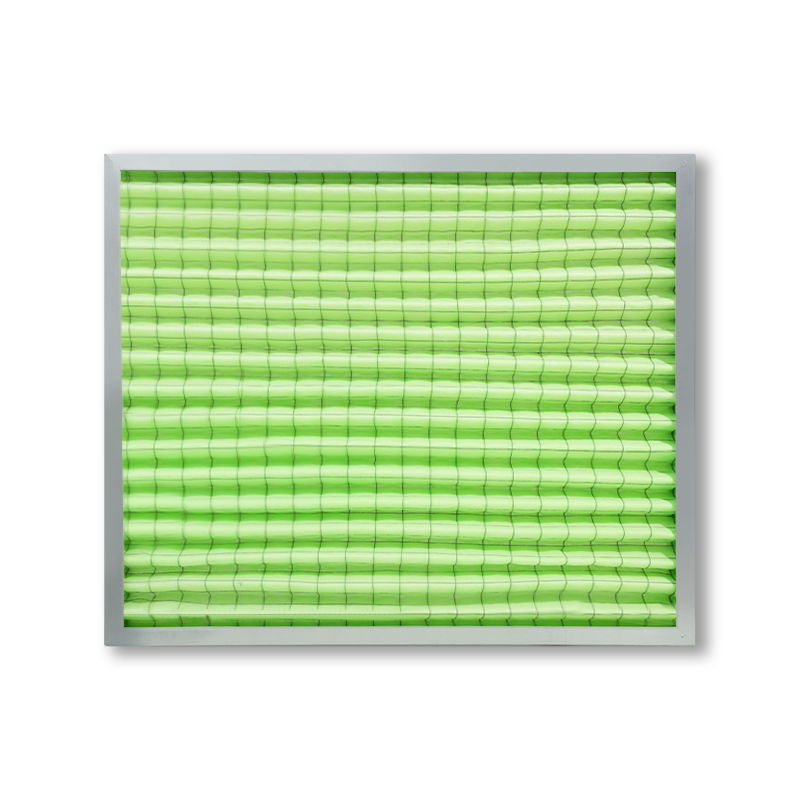
Primary filters — also called pre-filters, coarse filters or G-class filters — are the first air-cleaning stage in an HVAC system, and their job is to capture large particles from 5 micrometers upward so that every downstream component survives long enough to earn its cost. They typically remove 80–95% of airborne dust by weight while contributing only 25–50 Pa of initial pressure drop, and they cost a small fraction of the medium and HEPA filters they protect.
Their importance rests on three measurable outcomes:
- They extend downstream filter life by a factor of 2 to 5, converting frequent replacement of expensive HEPA elements into infrequent replacement of inexpensive pre-filters.
- They keep cooling and heating coils clean. A coil fouled with a 5 mm dust layer can lose 15–25% of its heat transfer capacityand force the system to run longer for the same output.
- They protect fans, dampers, humidifiers and duct interiors, keeping static pressure stable and reducing the frequency and cost of duct cleaning.
Selection comes down to six variables, in order of importance: efficiency class, face velocity and airflow rating, dust-holding capacity, initial and final pressure drop, frame and media construction matched to the environment, and physical dimensions with the correct sealing method. The rest of this article develops each of these with numbers you can apply directly.

What a Primary Filter Actually Does
Position in the Filtration Train
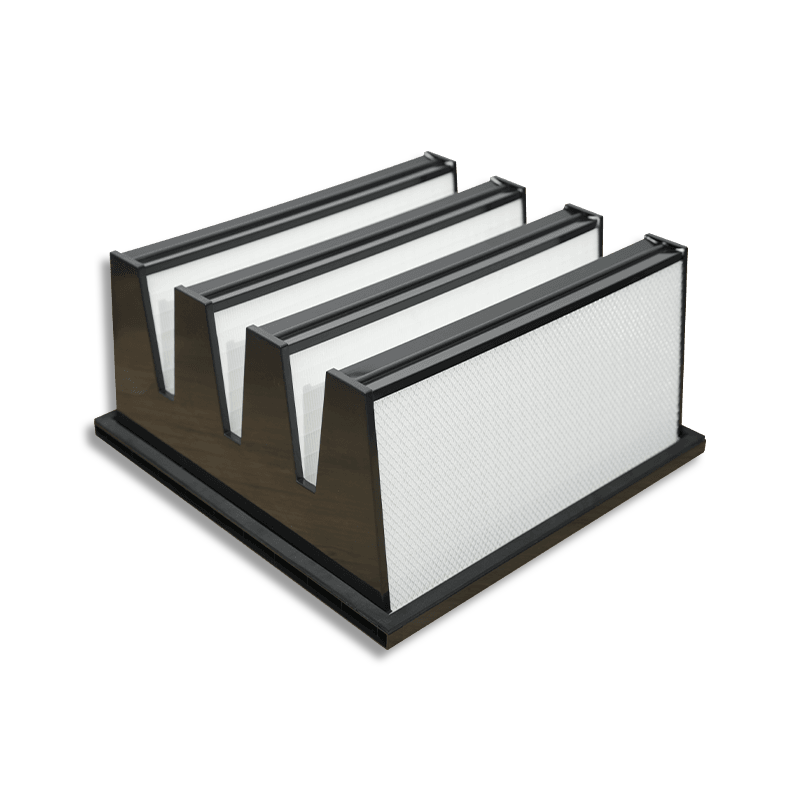
A standard commercial air handling unit uses a graded sequence: primary filter → medium-efficiency filter → high-efficiency or HEPA filter. Each stage removes the particle range it handles most economically and hands the remainder to the next. Placing a HEPA filter directly in raw outdoor air would load it with lint, insects, pollen and grit within weeks, wasting media that is designed for submicron particles.
The Capture Mechanisms at Work
- Interception— a particle following an air streamline passes within one particle radius of a fiber and touches it. Dominant for particles of 1–10 µm.
- Inertial impaction— heavier particles cannot follow the air as it bends around a fiber and collide with it. Dominant above 1 µm and stronger at higher face velocity.
- Sieving— particles physically larger than the gap between fibers cannot pass. Handles lint, fibers, hair and insects.
- Gravitational settling— coarse heavy particles drop out in low-velocity zones ahead of the media.
Because impaction and interception both strengthen as particles get larger, primary filters are most efficient precisely on the particles that would do the most damage to coils and fans.
The Particles Involved
|
Common airborne contaminants by size and the stage of filtration that normally captures them. |
||
|
Contaminant |
Typical Size |
Captured Primarily By |
|
Insects, leaves, lint |
> 100 µm |
Primary filter |
|
Textile fibers, hair |
30–200 µm |
Primary filter |
|
Pollen |
10–100 µm |
Primary filter |
|
Settled dust, sand |
5–50 µm |
Primary filter |
|
Mold spores |
2–20 µm |
Primary and medium filters |
|
Fine atmospheric dust (PM2.5) |
0.3–2.5 µm |
Medium and high-efficiency filters |
|
Combustion smoke, bacteria |
0.01–1 µm |
HEPA |
Why Primary Filtration Pays for Itself
Protecting Coils and Heat Transfer
Fin spacing on a typical cooling coil is 1.8 to 3.2 mm. Dust bridges those gaps quickly in unfiltered air, and the deposited layer acts as thermal insulation while restricting airflow. Field studies of fouled coils consistently show heat transfer losses of 15–25% and airflow reductions of 10–20%. Because the chiller or heat pump must then run longer to meet the same load, a clean coil maintained by good pre-filtration commonly translates into 5–15% lower HVAC energy consumption.
Extending Downstream Filter Life
A HEPA filter may cost 15 to 40 times as much as a primary filter of the same face area. Loading it with coarse dust is the most expensive possible way to remove lint. With a properly specified primary stage, downstream filter life extends by 2 to 5 times, and the arithmetic is decisive: replacing four pre-filters a year at modest cost to avoid one premature HEPA change is a straightforward win.
Keeping Fans and Ducts Clean
Dust accumulating on centrifugal fan blades unbalances the impeller, raises vibration and bearing loads, and reduces aerodynamic efficiency. Dust settling in ductwork provides substrate for microbial growth and eventually requires mechanical cleaning that can cost more than several years of filter replacement. A well-maintained primary stage is the cheapest duct-hygiene program available.
Supporting Indoor Air Quality Targets
Primary filters do not by themselves deliver clean-room or hospital air, but they make it achievable and sustainable. In systems where the final stage carries the IAQ responsibility, the pre-filter guarantees that the final stage is operating within its design loading rather than fighting a dust burden it was never intended to see.
A Worked Cost Comparison
|
Illustrative annual comparison for a single 10,000 m³/h air handling unit with and without a dedicated primary stage. |
||
|
Item |
Without Primary Stage |
With Primary Stage |
|
Medium filter changes per year |
3–4 |
1 |
|
Primary filter changes per year |
— |
3–4 |
|
Coil cleaning interval |
Annual |
Every 3–5 years |
|
Average coil heat transfer |
Degrades 15–25% |
Near design |
|
Relative filtration cost |
Baseline 100% |
40–60% |
Reading the Efficiency Ratings
EN 779 / ISO 16890 Coarse Classes
Primary filters are rated by arrestance — the percentage of synthetic test dust retained by weight — rather than by fractional efficiency on fine particles. Under the older EN 779 standard these are the G1–G4 grades; under ISO 16890 they appear as ISO Coarse xx%.
|
Coarse filter classes with approximate equivalences and typical pressure drop values. |
||||
|
EN 779 Class |
Arrestance |
Approx. MERV |
Initial Δp |
Typical Use |
|
G1 |
< 65% |
1–3 |
10–25 Pa |
Equipment screening only |
|
G2 |
65–80% |
4–5 |
20–35 Pa |
Light commercial, return air |
|
G3 |
80–90% |
6–7 |
25–50 Pa |
Most common general pre-filter |
|
G4 |
> 90% |
7–8 |
30–60 Pa |
Pre-filter ahead of F7–F9 or HEPA |
For the great majority of commercial buildings, G4 / MERV 8 is the sensible default: it removes nearly all the mass loading that matters while adding little resistance.
Why Arrestance and Fractional Efficiency Are Different Questions
A filter can show 90% arrestance by weight and still pass most particles by count, because coarse particles carry almost all the mass while fine particles carry almost all the number. This is a feature of the staged design, not a shortcoming — the primary filter is measured against the mass it must intercept, and the downstream stage is measured against the fine fraction it must resolve.
Selection Criterion One: Airflow and Face Velocity
Face velocity is the single parameter that most often separates a filter that performs as catalogued from one that does not.
Face velocity (m/s) = airflow (m³/s) ÷ filter face area (m²)
Design guidance by media type:
- Panel and pleated primary filters: 2.0–2.5 m/s, with 2.5 m/s treated as a practical ceiling.
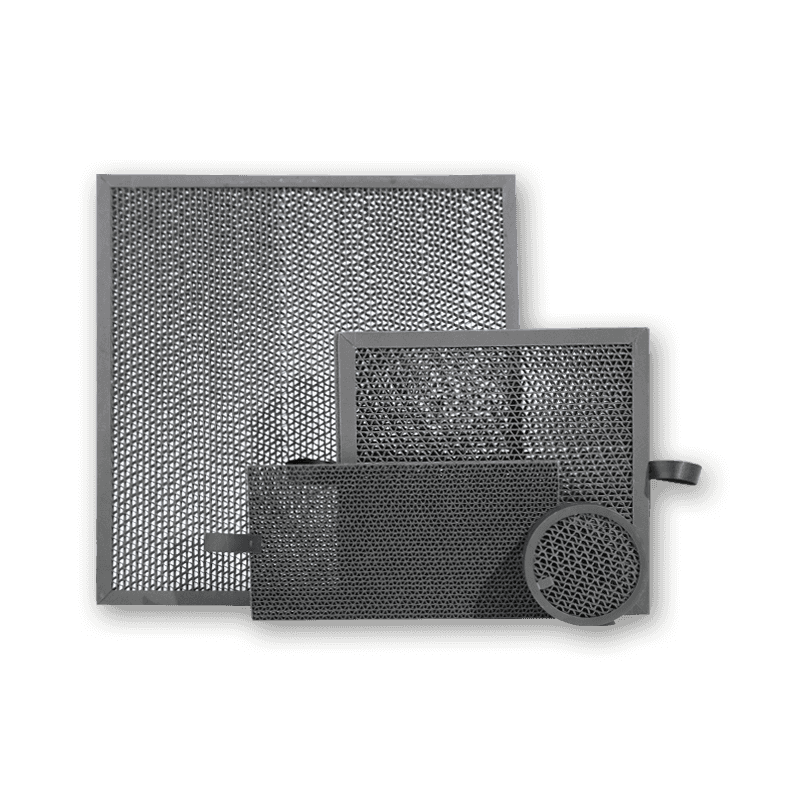
- Washable metal mesh: up to 3.0 m/s, since the rigid media tolerates higher velocity.
- Synthetic media rolls: 1.5–2.5 m/sdepending on thickness and loft.
Worked Example
An AHU handles 10,000 m³/h = 2.78 m³/s. Targeting 2.0 m/s gives a required face area of 2.78 ÷ 2.0 = 1.39 m². Using standard 592 × 592 mm panels (0.35 m² each), that means four panels — a 2 × 2 bank. Specifying only two panels would push face velocity to 4.0 m/s, well outside the design window.
Pleat Area as the Hidden Variable
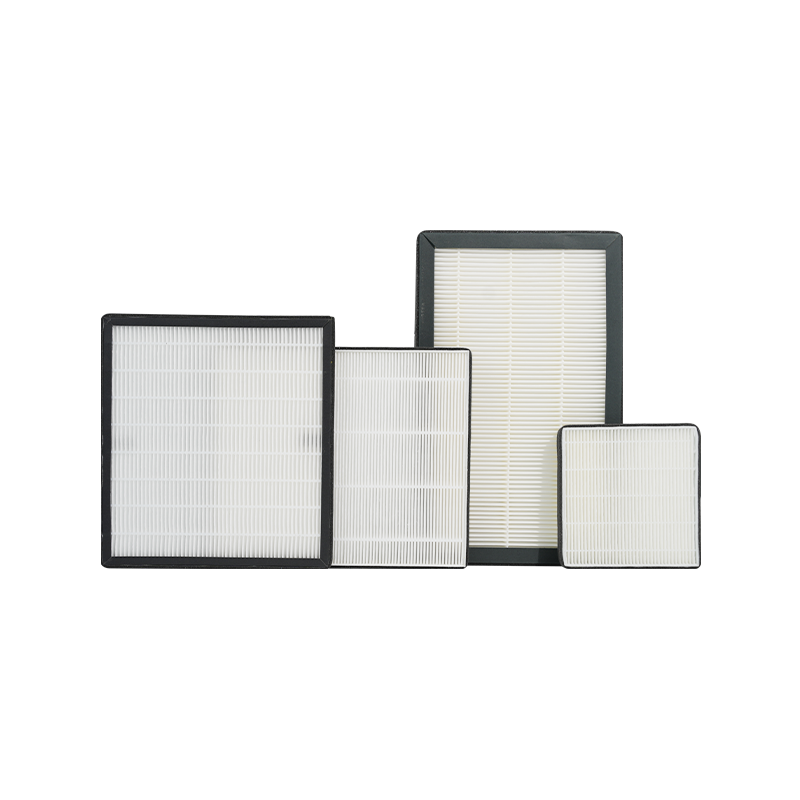
Two filters with identical 592 × 592 mm faces can differ greatly in media area. A flat panel offers about 0.35 m²; a deep-pleated 100 mm filter can offer 2 to 4 m² of media in the same opening. Because media velocity falls in proportion, the deep-pleated version holds several times the dust at comparable resistance. When comparing products, compare effective media area, not face dimensions.
Selection Criterion Two: Pressure Drop and Dust-Holding Capacity
Setting Initial and Final Resistance
Initial pressure drop for a clean primary filter should sit in the 25–50 Pa band at rated flow. The recommended replacement point — final resistance — is conventionally twice the initial value, or 150–250 Pa, whichever comes first. Operating beyond that point produces steeply rising fan energy for diminishing return.
The Energy Arithmetic
Fan power scales directly with pressure:
Fan power (kW) = airflow (m³/s) × pressure drop (Pa) ÷ (1,000 × fan efficiency)
For the 10,000 m³/h unit above at 65% fan efficiency, every 100 Pa of added resistance costs roughly 0.43 kW. Running continuously, that is about 3,750 kWh per year — frequently more than the entire annual filter budget. Choosing a low-resistance media with generous pleat area is therefore an energy decision as much as a filtration decision.
Dust-Holding Capacity
Dust-holding capacity (DHC) is the mass of test dust retained when the filter reaches final resistance, expressed in grams. Typical values for a 592 × 592 mm element:
|
Indicative dust-holding capacity and service life by primary filter construction, based on a standard 592 × 592 mm element. |
|||
|
Construction |
Media Area |
Dust-Holding Capacity |
Typical Service Life |
|
Flat synthetic panel |
0.35 m² |
80–150 g |
1–2 months |
|
Pleated panel, 46 mm |
1.0–1.5 m² |
250–400 g |
3–4 months |
|
Pleated panel, 100 mm |
2.5–4.0 m² |
500–900 g |
6–12 months |
|
Pocket / bag, G4 |
3.0–5.0 m² |
700–1,200 g |
6–12 months |
|
Washable metal mesh |
0.35 m² (multi-layer) |
100–200 g per cycle |
Washed monthly, 5–10 years |
The practical conclusion: compare filters on cost per gram of dust held, not on unit purchase price. A deep-pleated element at double the price that lasts three times as long and adds less resistance is the cheaper choice on every axis.
Selection Criterion Three: Media and Frame Construction
Media Options
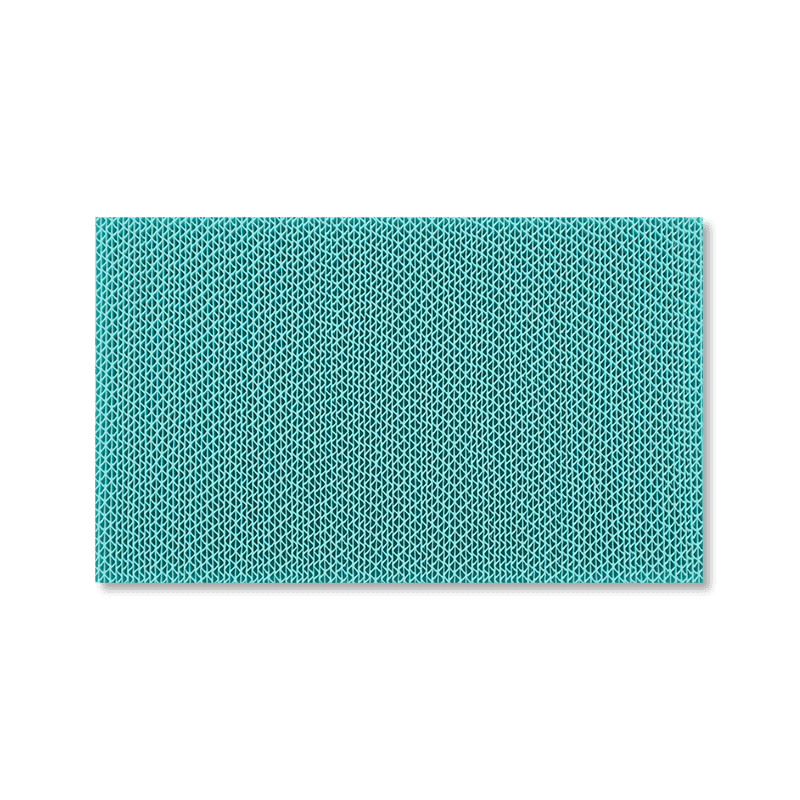
- Synthetic polyester non-woven— the mainstream choice. Moisture-resistant, dimensionally stable, available in graded-density constructions where fiber density increases toward the downstream face for progressive depth loading.
- Polypropylene meltblown— fine fibers, low basis weight, good efficiency at low resistance; often electrostatically charged to raise capture on mid-size particles.
- Glass fiber— high temperature tolerance, suited to heated air streams and industrial duty.
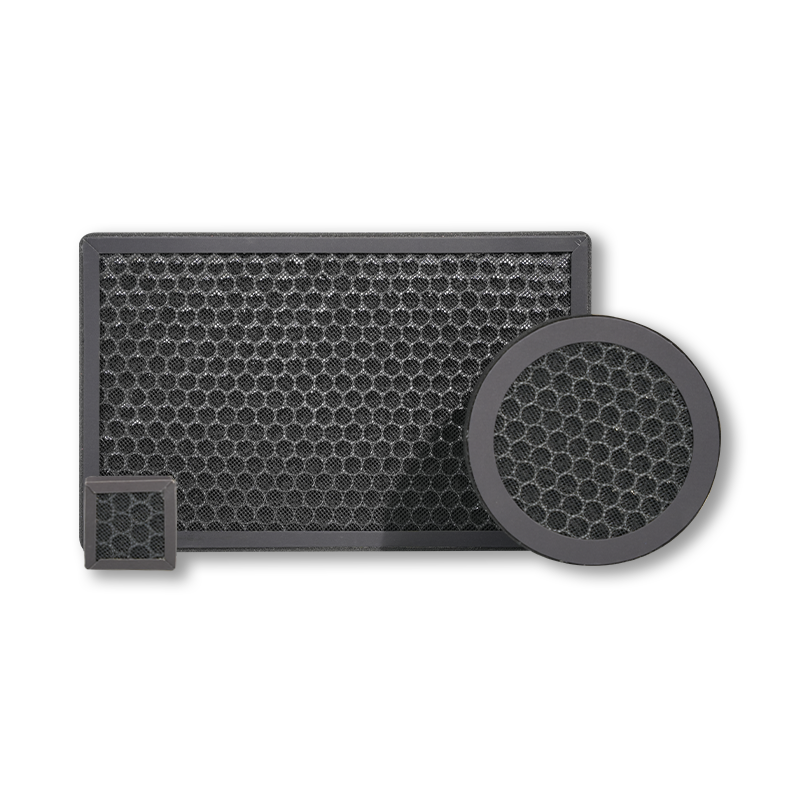
- Aluminum or stainless mesh— washable and reusable, ideal for kitchen exhaust, grease-laden air and high-humidity intakes.
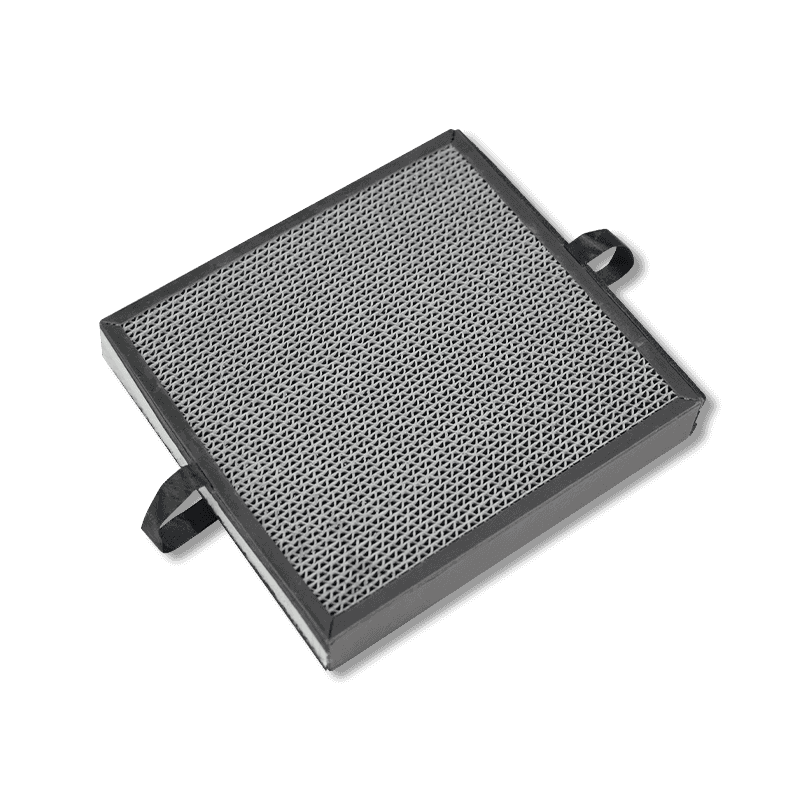
- Activated-carbon-loaded non-woven— adds gas and odor control where the intake is near a roadway, loading dock or exhaust stack.
Frame Options
|
Frame materials for primary filters and the conditions each suits best. |
|||
|
Frame Material |
Temperature Limit |
Humidity Tolerance |
Best Application |
|
Cardboard / kraft |
60 °C |
Up to ~80% RH |
Dry indoor return air, disposable use |
|
Galvanized steel |
120 °C |
High |
Outdoor air intakes, general AHU duty |
|
Aluminum |
120 °C |
High |
Washable units, weight-sensitive installs |
|
Stainless steel |
250 °C+ |
Very high |
Kitchens, labs, cleanrooms, coastal sites |
|
ABS / engineered plastic |
70 °C |
High |
Residential and light commercial units |
Fire Rating
Filters installed in commercial air handling systems should meet UL 900 Class 1/Class 2 or the equivalent EN 13501-1 classification required by local code. Confirm the certification on the product datasheet rather than inferring it from the media type.
Selection Criterion Four: Matching the Environment
|
Recommended primary filter specification by building type and ambient dust conditions. |
|||
|
Environment |
Recommended Class |
Preferred Construction |
Change Interval |
|
Office, clean urban air |
G4 / MERV 8 |
Pleated synthetic panel |
3–6 months |
|
Hospital / laboratory |
G4 pre-stage |
Metal-framed, gasket-sealed |
2–3 months |
|
Industrial, high dust |
G4 deep-pleat or pocket |
100 mm depth, steel frame |
1–2 months |
|
Commercial kitchen |
G2–G3 mesh |
Washable stainless baffle |
Washed weekly |
|
Coastal / high humidity |
G4 |
Moisture-resistant synthetic, metal frame |
3–4 months |
|
Data center |
G4 / MERV 8 |
Low-Δp deep pleat |
6–12 months |
|
Near construction site |
G3 + G4 in series |
Two-stage coarse bank |
2–6 weeks |
Where outdoor PM10 regularly exceeds 150 µg/m³, a two-stage coarse arrangement — a washable mesh screen ahead of a disposable G4 — usually gives the lowest total cost, since the screen absorbs the heaviest loading and is simply rinsed.
Selection Criterion Five: Dimensions, Sealing and Installation
Standard Sizes
Metric AHU modules are built around 592 × 592 mm and 592 × 287 mm nominal openings with depths of 21, 46, 96 and 100 mm. Imperial systems use 24" × 24", 24" × 12" and 20" × 25" with 1", 2" and 4" depths. Staying with standard sizes keeps replacements available off the shelf and avoids the lead time and premium of custom elements.
Bypass Leakage Is the Decisive Detail
Air takes the path of least resistance, so any gap around the frame carries disproportionate flow. A 3 mm gap around a 592 × 592 mm filter can allow on the order of 5–10% of total airflow to bypass the media entirely, and that bypassed air carries its full dust load straight to the coil. Every percentage point of rated efficiency is irrelevant if the seal fails. Practical measures:
- Specify filters with a continuous closed-cell gasket on the upstream or downstream face.
- Use spring clips or cam-lock holding frames that apply even compression across the gasket.
- Verify the track and frame are straight and undamaged at each change-out.
- Check airflow direction arrows — pleated media installed backward loses a meaningful share of its capacity.
Access and Service Clearance
Allow at least the filter depth plus 300 mm of clear space in front of the bank for removal. Filters that are difficult to reach get changed late, which undermines the entire strategy regardless of how well the element was specified.
Monitoring and Replacement Strategy
Measure, Don't Guess
Install a differential pressure gauge or transmitter across every filter bank, with a range of 0–500 Pa and a marked alarm setpoint. Visual inspection is an unreliable indicator: a filter can look grey and still have most of its capacity, or look acceptable while carrying fine dust deep in the media.
Recommended Practice
- Record the clean-filter Δp at commissioning as the baseline for every future comparison.
- Replace when Δp reaches twice the initial value or 200 Pa, whichever comes first.
- Log readings monthly to build a loading curve; a curve that steepens signals a change in ambient conditions worth investigating.
- Replace the primary stage on its own schedule, and time downstream changes to coincide with a fresh pre-filter.
- Bag loaded filters at removal to keep captured dust from re-entering the plant room.
Total Cost of Ownership
Evaluate candidates on the full picture rather than the invoice line:
Annual cost = (filter price × changes per year) + labor + energy from average Δp + share of downstream filter and coil cleaning cost
In most continuously operating systems, energy attributable to pressure drop is 60–80% of the lifetime cost of a primary filter, with purchase price a minority share. That single ratio should drive the specification more than any other consideration.
A Practical Selection Checklist
- Confirm design airflow in m³/h and convert to m³/s.
- Divide by a target face velocity of 0–2.5 m/sto obtain required face area, then set the bank layout.
- Select efficiency class from the environment table — G4 / MERV 8 unless conditions argue otherwise.
- Choose the deepest pleat the housing accepts to maximize media area and dust-holding capacity.
- Verify initial Δp is below 50 Paat the actual design flow, not at the catalogue reference flow.
- Match frame and media to temperature, humidity and any grease or chemical exposure.
- Confirm the fire classification required by local code.
- Specify gasketing and a positive holding frame to eliminate bypass.
- Fit a differential pressure gauge and record the clean baseline at handover.
- Calculate annual cost including energy before comparing quotations.